One of the reasons I haven’t posted on this blog recently is that I’ve been busier with the scholarly side of my life. I just presented a metal-related paper at the Music Theory Midwest 2017 conference in Iowa City, IA, so I thought I’d share my abstract. Continue reading
Chorus Without Words: Iron Maiden “Remember Tomorrow”
StandardA sarcastic urban dictionary entry defines the chorus as “The part of a song you actually remember,” and there’s more to that joke than just the humor value. In most popular music, the chorus can easily be identified because it is uses the same lyrics each time we hear it, and it frequently uses the title of the song. Most definitions of chorus mention the repetition of text or appearance of the song title; for example, in his massive two-volume study of the Beatles’ music, Walter Everett says that “The chorus, which gets its name from a usual thickening of texture from the addition of backing vocals, is always a discrete section that nearly always prolongs the tonic and carries an unvaried poetic text” (Everett 1999, p. 19). The repetition of lyrics in the chorus sets off that section from the verse, which usually has different lyrics each time it is heard. “the verse is to be understood as a unit that prolongs the tonic….The musical structure of the verse nearly always recurs at least once with a different set of lyrics” (Everett 1999, p. 15). Because we hear the chorus sung the same way over and over, it becomes the most memorable part of the song
But in Iron Maiden’s “Remember Tomorrow,” this definition doesn’t work. There is a part of the song with repeating text: the stanza that begins at 0:21 is repeated almost exactly at 3:55. But it’s not that memorable or something you’d normally sing along with, and the same music occurs at 1:28 with different lyrics. That would mean that this song has a chorus and a single verse, followed by a long bridge, then a second chorus, which would be a really odd song form. It makes a lot more sense to view each of the sections with lyrics (which all have the same music) as verses, with the first and last verse having the same lyrics. Then does this song even have a chorus? Continue reading
Interrogating the Origin Myth of Celtic Frost
StandardDear Readers, I’ve recently started writing for the International Society of Metal Music Studies blog. Some of my pieces will now be hosted there, but every time I write for them I will also post the lede paragraph of each article here. Please visit the ISMMS site to view this whole post, and while you’re there read through a few posts by their other excellent writers!
The history of Celtic Frost begins with the band Hellhammer. Hellhammer was founded as a trio in 1981 and released a couple of demos and an album before the members decided to end the Hellhammer project and reform under the name “Celtic Frost.” The band has promoted the idea that their work as Hellhammer was amateurish and earned such a bad reputation that they had to change their name to get people to take their music seriously. While I’m sure there is some truth to this story, the fact is that not *everyone* hated Hellhammer. One of the early German fanzines I’ve been reading recently actually gives a glowing positive review of Hellhammer’s first release! But it doesn’t entirely contradict the story Celtic Frost tells, just adds some fascinating nuance.
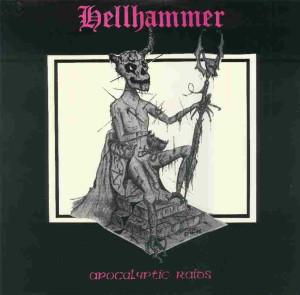
Hellhammer’s Apocalyptic Raids EP (1984)
Turnarounds and Tonality in Ozzy Osbourne’s “Crazy Train”
StandardThis article is about a technique in metal song composition that hasn’t received it’s fair share of attention, the turnaround. “Turnaround” is a term used more broadly than just metal, and it comes from blues music, where it describes a figure at the end of a twelve- or sixteen-bar blues that leads into the next verse or cycle of the blues form. Its use in metal is a bit more specific, and has to do with defining key. My goal is to explain a neat ambiguity of tonality in a turnaround used in Ozzy Osbourne’s song “Crazy Train” (and by “ambiguity I mean two conflicting possibilities, not vagueness). But to understand what’s happening in “Crazy Train,” you’ll need to know how turnarounds are used in riff-based metal songwriting.
Most metal music, and a lot of hard rock as well, is based on the repetition of a distinctive rhythmic/melodic unit called a “riff.” Riffs are often either repeated exactly, or varied slightly in a few ways. One example of exact repetition is the verse of “Crazy Train” by Ozzy Osbourne, which repeats the same guitar riff several times in a row without changing it.
Inversions of Values in Ghost’s “Cirice”
StandardDear Readers, I’ve recently started writing for the International Society of Metal Music Studies blog. Some of my pieces will now be hosted there, but every time I write for them I will also post the lede paragraph of each article here and link to the full version on their site. Please visit the ISMMS site to view this whole post, and while you’re there read through a few posts by their other excellent writers!
If you don’t know the Swedish band Ghost yet (used to be spelled “Ghost BC” in the US for legal reasons), you might not be paying much attention to metal industry news. They are a rapidly rising star in the metal cosmos: their latest album hit the top of the charts in Sweden and charted no. 8 in the United States (these days, breaking into the top 10 is a rare feat for a non-American metal band), and the band even won the Grammy for Best Metal Performance for their song “Cirice” this past year. They have attracted some controversy for their costume gimmick: their lead singer “Papa Emeritus” dresses as a sort of dark, Satanic “anti-pope,” while the rest of the band call themselves “nameless ghouls” and wear identical masks with dark overtones. The band members seem to have a tongue-in-cheek attitude about their Satanic image as an inversion of traditional Christian symbols (literally inverted in the case of the cross that forms a part of the band’s logo). But this Satanic symbolism is only the most superficial layer of a deep practice of inverting values that can be seen throughout the band’s work, not just in their visual imagery, but also in their lyrics, timbre, and even in the formal properties of their treatment of verse material during the guitar solo. Each of these dimensions undermines established associations of evil with dissonance, discord, and ugly harshness in metal music.
…. Continue reading this article at the International Society for Metal Music Studies blog.
7/8 or 4/4? Measuring Meter in Metallica’s “Kill ‘Em All”
StandardIn a previous post on this blog, I investigated an oddly-timed riff from Metallica’s “Master of Puppets” that is allegedly in 5/8 meter. This certainly isn’t the only song in which Metallica does really interesting things with their timing—meter changes and tempo changes are practically a basic element of the band’s style in their early albums, and their music would sound really different if they followed a metronome nailed to a single tempo for each song. But there are also several riffs like the one I analyzed from “Master of Puppets” that don’t easily fit into a recognizable meter. In this post, I’ll be looking at a riff that accompanies the guitar solo in their first original song “Hit the Lights.” This riff is usually transcribed with a 7/8 measure at the end, but I’ll be arguing that it actually never changes out of 4/4.
This riff begins at 2:35 in the album version of “Hit the Lights,” right after the third verse. After a few repetitions of the riff, it is transposed up a whole step and continues underneath the guitar solo. This riff is then repeated kind of like a vamp through to the end of the song.
Disconnecting Rhythm and Pitch in Meshuggah’s “Nostrum”
StandardThe paradigm-defining Swedish progressive metal band Meshuggah just released their new album The Violent Sleep of Reason today, but we’ve already had weeks to listen to two singles the released leading up to the album: “Born in Dissonance” and “Nostrum.” There’s any number of things I could say about how bone-crushingly heavy these two songs are, which you can probably read in a hundred other blogs and metal industry news sites. I could also talk about how the band is continuing to use some of the same riff-writing techniques the band has used for decades. I could even show how many songs on the new album are great examples of musical structures scholars and fans have already found in Meshuggah’s music. (Meshuggah has definitely attracted it’s fair share of scholarly research — conference papers, several Master’s theses, chapters in doctoral dissertations, and even an article in one of the most prominent music theory research journals, Music Theory Spectrum.) But instead, I’d like to talk about something Meshuggah does in “Nostrum” that I don’t think I’ve ever seen before, either in writing about the band by other critics and scholars, or in my own analyses.
(Update October 11, 2016: Dr. Olivia Lucas, who received her PhD from Harvard this last May, has just written me to tell me that in chapter 2 of her dissertation about extreme metal, she observes a similar kind of isorhythm to what I describe here in the Meshuggah song “Pineal Gland Optics” from ObZen (2008). She pointed out that in “Pineal Gland Optics” the pitches form a repeating pattern, but in the second riff from “Nostrum” there is no repeating sequence of pitches, so it’s not exactly the same, but it’s pretty similar. Based on the few pages I’ve just read, I highly recommend her dissertation to anyone interested in rhythm and meter in Meshuggah’s music!)

Mixed Reviews: Early Review of Metallica’s “Ride the Lightning” (translated from German)
StandardSorry I haven’t posted in a while! I’ve been hard at work on other things in my life (like starting to write my dissertation). I have a research project about Metallica that is gradually making some progress, though, because I’ve spent a fair amount of time scouring the internet for interviews with the band and reviews of their early releases and performances. Unfortunately I wasn’t able to find as many sources from the early- and mid-1980s as I had hoped for—that is, until I put a search into Jason Netherton’s incredible fanzine archive Send Back My Stamps! which has a number of German zines with articles about Metallica dating from 1984 or 1985. I think part of the reason I had missed these until now is that I was searching in English. Also, where else on the internet can you find scans of photocopied amateur metal zines from thirty years ago? Really, there is nowhere else. Thanks to Jason Netherton for putting together such an amazing resource!

Logo from the cover of Speed Attack #2 (1985). For all of issue #1, where this review came from, see <https://sendbackmystamps.org/2013/10/16/speed-attack-1-germany-1984-auf-deutsch>
What follows is my own transcription and translation of a review by “Peter” appearing in the German fanzine Speed Attack #1 (1984). Continue reading
Vamp or Cadence? Exploring Strategies for Ending Songs in Motörhead’s “Overkill”
StandardI’ve been looking at two Motörhead albums very closely this week: Overkill (1979) and Ace of Spades (1980). Motörhead is a unique band with a unique relationship to genre. Many metal critics relate them to the British punk explosion (and implosion) of 1977, ((For example, Ian Christe introduces Motörhead at the end of a section about the ’77 punk moment. See Christe’s 2003 book Sound of the Beast: The Complete Headbanging History of Heavy Metal, p. 29.)) but Motörhead outlived the career of virtually any 70s punk band and remained relevant thanks in part to a close relationship with a metal scene that they were never really entirely within. Motörhead served as an influence and even a kind of godfather to the New Wave of British Heavy Metal (NWOBHM) that took off in the early 80s; Lemmy Kilmeister (RIP, Dec. 2015) was from an older generation than most of the British teenagers that formed bands like Saxon and Diamond Head at the end of the seventies, but despite steering clear of all of the musical tendencies and lyrical trappings of the kind of heavy metal these bands began producing, Motörhead frequently shared venues with the NWOBHM bands and even developed close working relationships with some of them (especially Girlschool, who released a split EP with Motörhead in 1981). The two Motörhead albums I’ve been looking at are from the year or so in which they first became successful on the British charts. ((Only a few of Motörhead’s most recent albums sold well enough in the United States to make it in the top half of the Billboard 200.))
One of Motörhead’s most famous singles is “Overkill,” and though most people say it is important because it introduced the use of two bass drums to heavy metal, I think another reason it’s significant is that it really creatively plays with the conventions of ending a song. Continue reading
Primary Sources Page
StandardDear Readers,
I just wanted to announce a new resource I’ve put together listing primary sources about metal music. It seems like every week there’s exciting documents, recordings, and information about the history of metal and rock music being made available for free online. You can read through the collection I’ve put together by clicking on this link, or by clicking on the new “Primary Sources” link on the navigation bar to your left.
I’ll try to add good resources as I come across them. Feel free to contact me if you know of a great site that could be valuable to others interested in studying heavy metal and hard rock and their more recent incarnations. For now, here are a couple of pieces that illustrate what kind of amazing resources are becoming available.
1. Aardschok No. 1
The Dutch metal magazine Aardschok is one of the earliest publications about metal that is still running today. While it’s now a glossy, full-color commercial magazine, their first issues from the early 80s look like they were put together with an electric typewriter, scissors and tape, and a black and white photocopy machine, like the fan-made zines from the rest of the 80s and 90s that connected the underground metal community before the internet era. Aardschok has recently made their first four issues available online. I’ve selected from their first issue this review of a 1980 concert by Girlschool, an excellent early New Wave of British Heavy Metal group that just happened to be all-female.

2. Euronymous of Mayhem talks about his domestic life
Death-metal-bassist-turned-author Jason Netherton is putting together a fantastic collection of early metal fanzines, many of which are scanned and available online at SendBackMyStamps.org. There’s literally dozens of different fan-made publications from countries all over the globe, featuring early interviews with too many bands for me to count. It’s absolutely fantastic what he’s drawn together. It was really hard to choose something to share here out of all of the incredible interviews and album reviews, but I decided on this decidedly mundane moment with the much-mythologized guitarist Euronymous from the pivotal Norwegian Black Metal band Mayhem. If you want to read the rest of the interview, which appeared in the Polish fanzine Holocaust in 1990, you can browse through that whole issue of the magazine here.
[Interviewer:] How’s life in Norway?
[Euronymous:] Norway is an OK place to live in, except for that everything costs a fortune here, and I wouldn’t mind getting rid of the winter. Here we pay $1 for a litre of milk, $1-2 for a bread and $4-8 for half a litre of beer. Yeah, it sucks. The apartment we were living in recently costs $1230 a month… If you aren’t rich, it’s not too easy to live here.
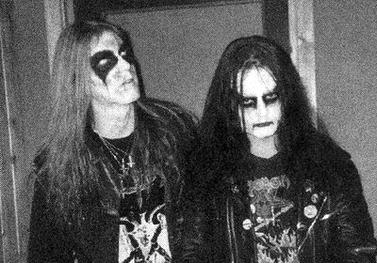
We have to spend so much money on food, man… we can barely afford all these leather jackets and medieval weapons! It’s such a BUMMER! *sigh* [photo: wikipedia]